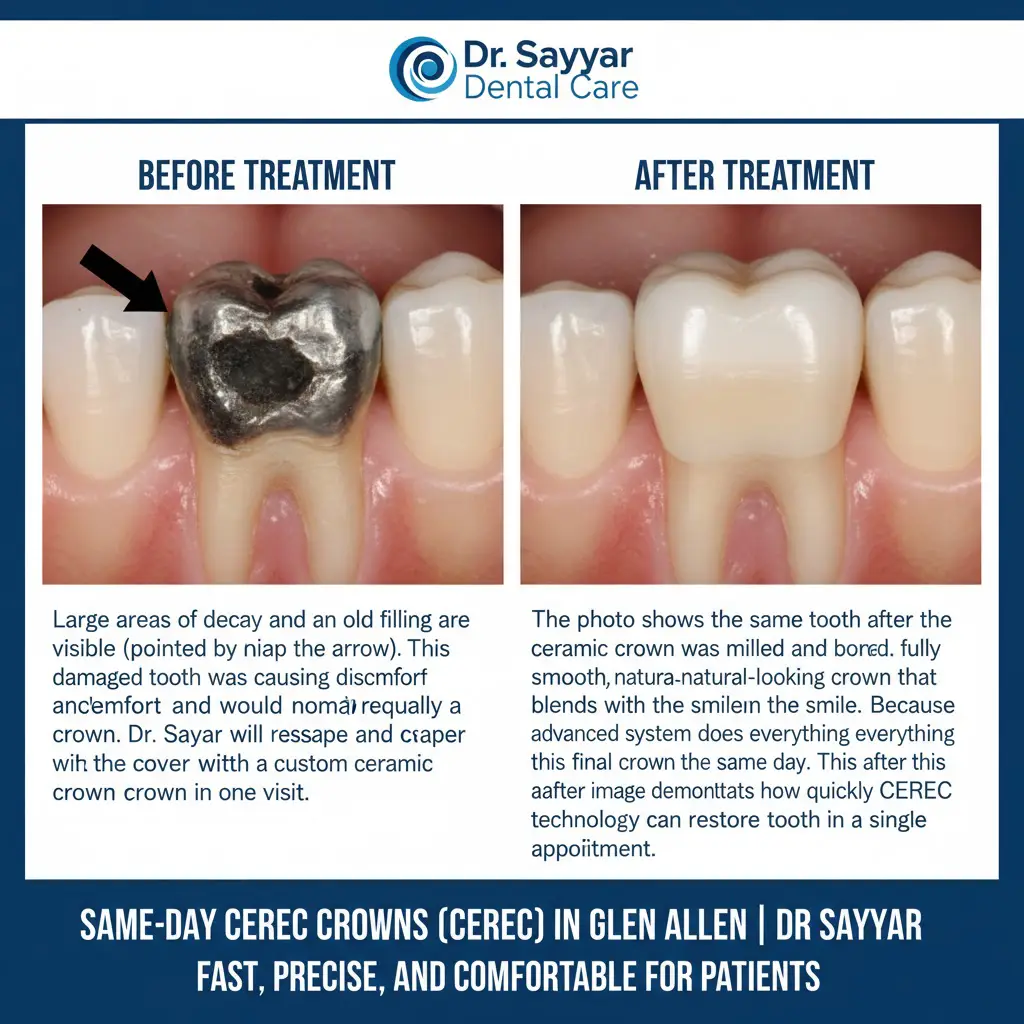
A crown used to mean two appointments two weeks apart, a putty impression that made you gag, a temporary crown that came off while eating, and being numbed a second time to fit the real one. Same-day CEREC crowns remove all four of those steps. You arrive with a broken tooth and leave the same afternoon with the finished crown cemented in place.
What is a CEREC crown?
CEREC stands for Chairside Economical Restoration of Esthetic Ceramic, which is a mouthful that describes something simple: designing and manufacturing a ceramic crown in the dental office while the patient waits, instead of sending impressions to an outside laboratory.
The crown itself is milled from a solid block of ceramic. It is not a temporary, a compromise or a stopgap. It is the final restoration, made from the same class of material a laboratory would use, and it is cemented the day it is made.
How does a same-day crown appointment work?
- Preparing the tooth. The area is numbed, decay or the broken portion is removed, and the tooth is shaped so a crown can seat over it. This part is identical to a conventional crown.
- Digital scan. A small camera takes a series of images and builds a 3D model of the tooth and the teeth around it. No impression tray, no setting material, nothing to gag on.
- Design. The crown is designed on screen against the scan, with the shape and the bite checked digitally before anything is manufactured.
- Milling. A milling unit cuts the crown from a ceramic block. This takes a matter of minutes rather than days, and you can usually watch it happen.
- Finishing and fitting. The crown is characterized and glazed, then tried in, adjusted for the bite and cemented. You chew on it the same day.
Total chair time is usually around two hours, much of it waiting while the crown is produced. Most patients bring something to read; some go and get a coffee.
Is a same-day crown as good as a laboratory crown?
For most situations, yes, and the evidence on chairside ceramic restorations is now substantial rather than preliminary. The fit of a digital scan is at least as accurate as a conventional impression, and arguably more consistent, because it is not affected by material distortion, bubbles or a tray that moved.
There is an honest qualification. Highly aesthetic front-tooth work, where the crown has to match a neighboring natural tooth with subtle translucency and internal characterization, can still benefit from a skilled ceramist building it by hand in layers. That is a small subset of cases. For molars and premolars, where strength and fit matter more than optical subtlety, a same-day ceramic crown is an excellent restoration.
We will tell you honestly which category your tooth falls into rather than pushing everything down the same route.
What are the real advantages?
- One appointment instead of two. For anyone taking time off work or driving in from Petersburg, Fort Lee or the far side of Richmond, this is the headline.
- Numbed once, not twice. The second injection at the fitting appointment disappears entirely.
- No temporary crown. Temporaries come loose, they leak, they are sensitive to cold, and they occasionally fall off at the worst possible moment. Removing that two-week window removes all of it.
- No putty impression. A genuine relief for anyone with a strong gag reflex.
- Less tooth structure removed in some designs. Digital design allows conservative preparations such as onlays, which cover only the damaged part of a tooth rather than the whole thing.
- Fewer chances to go wrong. Each handover between office and laboratory is a point where information can be lost. There are none here.
When is a crown the right treatment at all?
This is worth separating from the question of how the crown is made. A crown is indicated when a tooth is structurally compromised rather than merely imperfect: a cracked tooth, one with a very large old filling and little remaining structure, one that has been root treated, or one broken by trauma.
A crown is not the right answer for a small cavity, which needs a filling, nor for a healthy tooth you simply dislike the color of, which is a case for whitening or a more conservative cosmetic option. Crowning a healthy tooth removes sound structure that never grows back.
Where a tooth is so badly broken that there is nothing left to hold a crown, the conversation becomes one about saving the tooth or replacing it; our article on root canal versus extraction covers how that decision is made.
How long do CEREC crowns last?
Studies of chairside ceramic restorations report survival rates comparable with conventional laboratory crowns, with the large majority still functioning well after a decade and many considerably longer. The ceramic itself rarely wears out.
What ends a crown’s life is almost always something happening at its edge or underneath it. Decay at the margin, where crown meets tooth, is the most common reason a crown has to be replaced, and it is entirely preventable with daily cleaning along the gumline. Gum recession can expose the margin over time. And grinding is hard on ceramic, just as it is on enamel.
So the practical advice is unglamorous: clean the margin, keep your checkups so problems at the edge are caught early, and if you grind at night, wear the guard. Those three habits do more for the lifespan of a crown than the choice of material ever will.
Does it hurt, and what should you expect afterwards?
The appointment is done with the tooth fully numb, so preparation is comfortable. Afterwards, some sensitivity to cold and to biting pressure for a few days is normal, particularly on a tooth that was already inflamed before treatment. It settles.
What is not normal is a bite that feels high, as though that tooth is hitting first. It usually means the crown needs a small adjustment, which takes a few minutes. Do not live with it; a crown left high is uncomfortable and puts excess force on the tooth. Call and come in.
Likewise, sensitivity that is getting worse after the first week or two, rather than better, is worth checking rather than waiting out. Full aftercare guidance is on our crown and bridge care page.
Who is a good candidate?
Most people needing a crown on a back tooth are. The situations that need more thought are a front tooth requiring a precise aesthetic match to its neighbor, a tooth with active gum disease around it, which needs treating first, and a mouth with a severe grinding habit, where the plan has to include protecting the result.
Children and teenagers are a separate case, since teeth that are still erupting and gums that are still maturing change the planning. Our pediatric page covers care for younger patients.
What does a same-day crown cost?
Cost depends on the tooth, the material and what else the tooth needs, so you receive the full fee in writing after the examination and before anything is scheduled. We verify your dental benefits first and file the claim for you.
A point worth knowing: most dental plans treat a crown as a major restorative benefit and cover a proportion of it, typically subject to an annual maximum and sometimes a waiting period on newer policies. Whether the crown is made in one visit or two does not usually change how a plan treats it. We check the specifics of your plan before you commit rather than afterwards.
Veterans in Glen Allen, Petersburg and Fort Lee should see our veterans page for how VA dental benefits and VADIP plans work at a private practice.
Frequently asked questions
Can you really make a crown while I wait?
Yes. The design and milling take place in the office during your appointment, and the finished crown is cemented the same day. Expect around two hours in total, including the waiting.
Will it match my other teeth?
Shade is selected against your natural teeth and the ceramic is characterized and glazed before fitting. On back teeth the match is reliably good. On a front tooth sitting beside a natural one, we will discuss whether a laboratory-layered crown would match better in your particular case.
Is the digital scanner uncomfortable?
Far less so than the putty impressions it replaces. It is a small camera moved around the teeth; there is nothing to set, nothing to bite into and nothing to trigger a gag reflex.
Can a same-day crown be placed over a root canal?
Yes, and a root-treated back tooth usually needs that coverage, because it becomes brittle without it. Having the crown placed in the same period rather than months later is one of the practical benefits.
What if the crown breaks?
Ceramic can fracture under extreme force, most often in patients who clench or grind heavily or who bite something genuinely hard. Call us and we will look at it. Often the more important question is why it broke, because if grinding is the cause, replacing the crown without protecting it will produce the same outcome again.
Do I need to avoid anything afterwards?
Not once the crown is cemented, unlike a temporary. Normal eating resumes once the numbness wears off, which is worth waiting for so you do not bite your cheek. Sensible caution with very hard foods applies to any tooth.
Booking a consultation
If you have a cracked tooth, a large old filling that keeps giving you trouble, or you have been told you need a crown and want it done in a single visit, we are happy to look and tell you what is realistic for that tooth.
Request an appointment or call (804) 290-8001. Sayyar Family Dentistry is at 5231 Hickory Park Drive, Suite E, Glen Allen, VA, with free parking at the door.
Have a question about your smile?
Dr. Sean Sayyar and our team in Glen Allen, VA are here to help.