How Veterans Can Find the Right Dentist for Gum Treatment
Executive Summary: Veterans often have unique oral health needs and may qualify for special benefits when seeking gum (periodontal) treatment. In Virginia, many eligible veterans can receive dental care through VA programs or state assistance, reducing or eliminating out-of-pocket costs. Periodontal disease is a common but treatable condition (over 40% of U.S. adults 30+ have some form of it). Finding the right dentist – ideally a skilled periodontist or an experienced general dentist – is crucial. Sayyar Family Dentistry in Glen Allen (Richmond area) is well-positioned to serve veterans. The practice “welcomes new patients of all ages” and emphasizes personalized, compassionate care. It offers advanced technology (e.g. same-day CEREC crowns) and a team praised for efficiency and honesty by patients. This guide details veteran dental benefits, periodontal disease and treatments, how to choose a dentist, local clinic features, and the patient journey at Sayyar Family Dentistry.
Veterans’ Dental Benefits and Eligibility
Not all veterans automatically receive dental coverage, but many qualify under VA criteria. For example, any veteran who served 90 days or more on active duty (with an honorable discharge) may be entitled to a free VA dental exam if they apply within 180 days of separation. If a veteran has a service-connected dental disability (Class I) or is a former prisoner of war (Class IIC), they qualify for “any needed dental care”. Veterans with a 100% VA disability rating (or deemed unemployable) likewise qualify for any required care (Class IV). Even veterans with dental issues from combat trauma may receive full care (Class IIA) to maintain a “functioning dentition”. Gulf War-era veterans who apply promptly can get a one-time course of dental treatment (Class II).
For those who do not meet VA inpatient criteria, there are options. The VA Dental Insurance Program (VADIP) lets enrolled veterans purchase dental coverage. Additionally, under the VA MISSION Act, veterans can be referred to approved community dentists if the VA cannot provide timely care. In fact, VA news reports that about 40% of VA health care is now delivered through “community care” providers. In fiscal year 2025, nearly 890,000 veterans received VA dental care – many through community providers – and over 3.5 million dental procedures were completed.
Veterans should also explore state and local assistance. In Virginia, Medicaid (Cardinal Care Smiles) now covers comprehensive adult dental care. This includes exams, cleanings, fillings, root canals, extractions – and importantly “gum related treatment” – at no cost to qualifying members. Thus, lower-income veterans may receive free periodontal care through Medicaid. Community organizations and nonprofit dental programs may also offer discounted or free care for veterans in need.
In summary, many veterans do have access to periodontal treatment through VA benefits, VADIP plans, or Medicaid. It’s best to consult the VA Dental Benefits guidelines and ask local dentists if they accept VA patients or Medicaid. Sayyar Family Dentistry helps veterans navigate these options and will work with whatever coverage or budget they have.
Understanding Periodontal (Gum) Disease
Periodontal disease is a chronic infection of the gums and bone caused by bacteria in plaque. It often begins as gingivitis (inflamed gums that may bleed) and can progress to periodontitis if untreated. In gingivitis, gums become red, swollen, and prone to bleeding, but tooth support is still intact. If plaque (a sticky bacterial film) is not thoroughly removed, toxins irritate the gums and trigger the body’s immune response. Over time, this leads to gum pocket formation and breakdown of bone supporting the teeth. Advanced periodontitis is marked by deep pockets, receding gums, loose teeth, and eventually tooth loss.
Symptoms to watch for: Persistent redness, swelling or tenderness of the gums; gums that bleed easily during brushing or flossing; gums that pull away from the teeth; pockets (gaps) between teeth and gums; chronic bad breath or pus; loose or shifting teeth; and changes in bite or denture fit. Because gums can hide disease, regular dental exams are essential. In fact, more than 40% of American adults over 30 have some form of periodontitis, and it’s often painless until advanced. Risk factors include smoking, diabetes, certain medications, and genetics. Poor oral hygiene (infrequent brushing/flossing) accelerates gum disease.
Diagnosis: Your dentist will perform a periodontal evaluation: measuring pocket depths around each tooth with a probe, assessing gum recession, and taking dental X-rays to view bone levels. A comprehensive chart is often made to record depths and bleeding points. This classification (by stage and grade) helps determine severity and treatment.
Treatment overview: The goal is to eliminate plaque and tartar below the gumline and restore a healthy environment. Mild cases may be managed by a general dentist with improved home care and routine cleanings. For moderate to severe disease, specialized periodontal treatment is usually needed.
- Non-surgical therapies: The main approach is scaling and root planing (deep cleaning) – a careful cleaning of tooth roots under local anesthesia to remove plaque and calculus. This may be done with hand instruments or ultrasound scalers. Dentists also often use adjunctive antibiotics or antimicrobial rinses to reduce bacteria. After this intensive cleaning, gums can reattach to the tooth surface. Good home care (brushing twice daily with fluoride toothpaste and daily flossing) is critical to prevent recurrence. Regular professional cleanings (every 3–6 months) are essential for maintenance.
- Surgical procedures: If deep pockets persist or bone loss is severe, surgery may be indicated. Procedures include flap surgery (pocket reduction surgery), where the gums are lifted to allow thorough cleaning of roots and repair of bone. Bone grafts or guided tissue regeneration can encourage regrowth of lost bone. Soft tissue grafts (taking gum tissue from the palate) may cover exposed roots and rebuild gum height. In cases of tooth loss due to periodontitis, dental implants may be placed by a periodontist to restore function.
Periodontal treatment is tailored to each patient’s needs. Early-stage disease often responds to non-surgical care, while aggressive disease requires specialists. Studies show periodontitis has links with systemic health (e.g. diabetes and heart disease), so comprehensive treatment is important. Follow-up evaluations ensure healing and allow adjustments to the plan. Ultimately, the dentist’s goal is to stop disease progression and maintain a healthy mouth.
<div align=”center”>
| Treatment Type | Description | When Used |
| Scaling & Root Planing | Deep cleaning of roots to remove plaque/tartar (no surgery) | First-line for mild/moderate gum disease |
| Local/Oral Antibiotics | Antimicrobial medications (gel or pills) targeting bacteria | Adjunct when infection is active or pockets are deep |
| Flap Surgery (Pocket Reduction) | Surgical lifting of gums for deep cleaning | For persistent deep pockets (generally >5–6 mm) |
| Bone Grafting / Regeneration | Placing bone grafts or membranes to restore lost bone | To rebuild bone around teeth for support |
| Gum (Soft Tissue) Graft | Grafting tissue to cover exposed roots | For receding gums and to improve aesthetics |
| Dental Implants | Titanium implants replacing lost teeth | For tooth replacement after severe periodontal loss |
| </div> |
Choosing the Right Dentist
When seeking gum treatment, credentials and experience matter. Dental training: All dentists hold a DDS (Doctor of Dental Surgery) or DMD degree, which is a four-year professional program. Periodontists are dental specialists who complete an additional 3 years of advanced education in gum diseases and implant surgery. This extra training makes them experts in complex periodontal cases. General dentists can perform routine cleanings and may do mild gum treatments, but many will refer patients to a periodontist for advanced disease or implant cases.
To choose wisely, consider:
– Credentials: Verify the dentist’s license and specialty training. A periodontist will be board-eligible or board-certified in periodontology. Many dentists list their degrees and continuing education on their website or office materials.
– Experience with Veterans: Ask if the practice has treated other veterans or handles VA referrals. A veteran-friendly dentist should understand VA programs and be willing to assist with benefits. Many local practices, including Sayyar Family Dentistry, coordinate with insurance and benefits – one patient noted they “work with your insurance or any kind of budget” and discuss coverage details upfront.
– Technology & Comfort: Modern equipment can improve care. For example, Sayyar Dental uses same-day digital crown technology (CEREC) so that restorations take hours instead of weeks. A practice should also follow current safety standards: the ADA emphasizes strict infection-control guidelines based on CDC recommendations, and CDC resources stress safety in dental settings. You can ask about sterilization procedures and chairside protocols.
– Patient Feedback: Read online reviews. Patients of Sayyar Family Dentistry praise the caring staff and prompt service. One veteran shared that in an emergency they were seen within hours and received “absolutely FIRST CLASS service”. Another highlighted the dentist’s honesty and thorough explanation of insurance coverage. Another noted, “Dr. Sayyar… uses current technology and techniques” and that the “staff is wonderfully understanding, helpful and professional”.
Ultimately, the right dentist will combine technical skill with compassion. At Sayyar Family Dentistry, the team prides itself on a patient-centered approach, ensuring veterans feel comfortable and informed every step of the way.
Local Considerations in Glen Allen/Richmond
Location and convenience are important. Sayyar Family Dentistry is located at 5231 Hickory Park Dr., Suite E, Glen Allen, VA 23059, just north of Richmond. The office is easily accessible from major roads around Glen Allen/Henrico County. Ample free parking is available. The clinic hours are Monday–Thursday 8:00 AM–5:00 PM, Friday 8:00 AM–1:00 PM, closed on weekends. (Call for evening or emergency arrangements.) The facility is modern and spacious, with a welcoming waiting area and advanced treatment rooms. Sayyar Family Dentistry prioritizes accessibility: the building is handicap-friendly, and the team can arrange accommodations for veterans with special needs or mobility issues.
For urgent problems like sudden pain or swelling, the clinic does provide timely care. As noted, patients have been seen within hours of calling with an emergency. Veterans in acute need should call the office immediately at (804) 290‑8001. The staff will make every effort to schedule a prompt appointment or guide them to appropriate urgent care. Outside normal hours, the voicemail will give instructions for after-hours emergencies.
Sayyar Family Dentistry’s practice also features: up-to-date digital X-ray imaging for safer diagnostics, and patient education resources. Patients receive clear explanations of treatment options and costs before any procedure. The dental team speaks multiple languages and is sensitive to the needs of older adults and those with anxiety. Infection control follows strict ADA and CDC guidelines, so patients can trust in a safe environment.
Visiting the clinic is easy – veterans can call the office or visit the Contact Us page to find directions and hours. Sayyar Family Dentistry is just a short drive from downtown Richmond, making it convenient for veterans throughout the Richmond metro and northern Virginia.
Patient Journey at Sayyar Family Dentistry
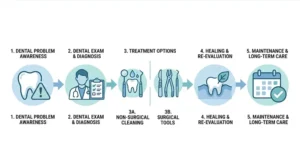
Veterans seeking gum treatment at Sayyar Family Dentistry can expect a guided, supportive experience. Below is a typical journey from the first contact through ongoing care:
(Scaling & Root Planing)
(Flap Surgery, Grafts, Implants)
(Regular Cleanings, Home Care)
First Visit (Consultation & Exam): The process begins by calling or booking an appointment online (via our Appointment page). On arrival, new patients complete health forms. Dr. Sayyar or a periodontist on staff reviews your medical history and asks about symptoms and concerns. The clinician then examines your teeth and gums, measures pocket depths, and takes any needed X‑rays. This comprehensive exam determines the extent of gum disease.
Assessment & Diagnosis: After gathering data, the dentist explains the findings. You learn whether you have gingivitis (early disease) or periodontitis (advanced disease), and what stage it is. Factors like smoking or diabetes are discussed, as these affect treatment. This is also a good time to discuss pain levels, dental anxiety, or scheduling constraints.
Treatment Plan: Together, you outline a plan. For many cases, initial therapy is non-surgical: thorough cleaning and root planing (usually over one or two visits). The dentist shows you the findings (e.g. deep pockets) and explains what scaling entails. If pockets are very deep or bone loss is present, the plan may include surgical options such as flap surgery or grafting. Dr. Sayyar will explain each procedure’s purpose, benefits, and recovery. A financial coordinator will review costs, insurance/VA benefits, and payment options up front. Veterans can provide their DD214 or VA disability info if seeking VA-covered care.
Treatment Delivery: On treatment days, the team ensures your comfort. Local anesthesia is used generously. The dentist or periodontist performs the agreed procedures using gentle, efficient techniques. Sayyar Family Dentistry often uses advanced tools (like ultrasonics) to clean deeply with less discomfort. For surgical visits, the dentist closes incisions carefully and provides post-op instructions.
Follow-Up and Maintenance: After initial therapy, you return for a re-evaluation. The dentist checks how the gums have healed and measures pocket depths again. Often, gums will shrink around teeth. If pockets are still moderately deep, another cleaning may be done. Once disease is controlled, the patient enters a maintenance program: regular professional cleanings every 3–4 months, plus strict home care. The team reinforces brushing twice daily with fluoride toothpaste and daily flossing (a vital habit to remove plaque). Sayyar Dental provides custom home-care instructions (e.g. [Night Guard Care, Implant Crown Care, etc.]) to support healing.
Patient Education: Throughout, Sayyar Family Dentistry emphasizes education. You’ll learn how to check your gums, use interdental brushes or water flossers, and choose an antimicrobial mouthwash if needed. The goal is to empower veterans to maintain oral health long-term.
Results: With diligent care, most patients see significant improvement. Gums become pink and tight, and pocket depths decrease. Even after advanced disease, many teeth can be saved that would otherwise have been lost. Patients often report not only a healthier mouth but a boost in overall wellness and confidence.
Ready to schedule? Our team is here to help veterans every step of the way. Call us at (804) 290‑8001 or book an appointment online today to start your treatment plan.
Frequently Asked Questions
Q: Are veterans automatically covered for gum disease treatment?
A: Not automatically. Coverage depends on VA rules. Veterans with service-connected dental conditions, high disability ratings, or other qualifying factors may receive full periodontal care through the VA. Others may get limited care (for example, a one-time course of treatment) if they meet specific criteria. Always check VA eligibility guidelines or consult a VA counselor.
Q: What’s the difference between a periodontist and a general dentist?
A: A periodontist is a specialist who has completed an additional 3 years of advanced training after dental school, focusing on gum diseases and implants. They handle complex cases like severe periodontitis and surgical treatments. A general dentist (DDS/DMD) provides routine dental care and can treat mild gum issues but will typically refer advanced cases to a periodontist.
Q: How painful is periodontal treatment?
A: Most gum treatments are done under local anesthesia, so you should feel minimal discomfort during the procedure. Afterward, some soreness or sensitivity is normal (often managed with over-the-counter pain relievers). Our practice uses gentle techniques and will ensure you are comfortable and well-informed before, during, and after treatment.
Q: Will my insurance or VA benefits cover treatment at this clinic?
A: We work with many insurance plans and VA programs. If you have VA dental coverage or Medicaid, bring your information to your appointment. Our staff can submit claims on your behalf. We will explain any portion not covered by insurance and discuss payment options. Patients report our team is “honest and works with your insurance or any kind of budget” to minimize surprise costs.
Q: How long does periodontal treatment take?
A: It depends on severity. A deep cleaning (scaling and root planing) might require 1–2 visits. Surgical procedures require more recovery time. In many cases, however, we strive to complete care efficiently. For example, our office provides certain restorations (like crowns) in a single 2-hour visit, so you can get comprehensive care without lengthy delays.
Need immediate care? Sayyar Family Dentistry strives to help veterans promptly. Call (804) 290‑8001 or visit our Appointment page to schedule an exam. The friendly team at our Glen Allen office is trained in veteran care and will guide you through benefits and treatment options. Don’t wait to protect your smile – contact us today!
Sources: U.S. Department of Veterans Affairs (VA) official guides and news; American Academy of Periodontology patient resources; American Dental Association (ADA) oral health topics; Centers for Disease Control & Prevention (CDC) dental infection control recommendations; Virginia Medicaid (DMAS) adult dental benefits; Sayyar Family Dentistry official pages. Each source is cited above with specific details.
Have a question about your smile?
Dr. Sean Sayyar and our team in Glen Allen, VA are here to help.