
VA Dental Paperwork and Gum Disease Treatment: Veterans’ Guide for Petersburg Glen Allen, VA
Executive Summary: Navigating VA dental benefits for gum disease (periodontal disease) can be complex. This guide breaks down the forms, eligibility rules, and processes veterans need to understand when seeking VA-supported dental care for periodontitis or gingivitis. We explain key VA forms by name and number (e.g., VA Form 10‑10EZ, 21P‑8416, etc.), required documents (DD‑214 discharge papers, dental exam records, VA rating letters), and step-by-step actions for applying, scheduling, and treating gum disease under VA benefits. We cover eligibility classes (e.g., Class I for service-connected dental conditions, Class II for Gulf War veterans, etc.), deadlines (like the 180‑day rule after discharge), treatment limits, and appeal rights. To help Petersburg and Glen Allen, VA veterans, we include local context and resources, along with internal links to our clinic’s pages (Contacts, About Us, Cavity Prevention) and a call to action. A comparative table of forms and a mermaid flowchart timeline help visualize the steps. All information is based on official VA sources to simplify the VA “bureaucracy” and make the process clear.
Eligibility for VA Dental Care
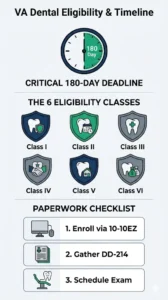
To receive VA-sponsored dental care (including gum disease treatment), veterans must first enroll in VA health care. You apply via VA Form 10‑10EZ (Veteran Health Benefits Enrollment Application). You won’t get dental benefits unless enrolled, so this is step one. Once enrolled, eligibility depends on your service and health condition. VA groups eligible veterans into categories (often called Class I, II, etc.):
- Class I – Compensable Service-Connected Dental Condition: If you have a service-connected dental disability rated 10% or higher (Schedule for Rating Disabilities 9900 series), you qualify for comprehensive VA dental care, including gum disease treatment, to maintain a “functioning dentition”. For example, a vet with combat trauma to the teeth may be eligible.
- Class II – Non-Compensable Dental Condition (Gulf War Era): If you have a non-compensable (0%-rated) dental condition that existed at discharge and you apply within 180 days of discharge (if post-9/30/81 service), VA will provide a one-time course of treatment to correct those specific conditions. Importantly, if you are a Gulf War vet, this one-time care is available once per eligible veteran (you can’t get more care after it’s done). Periodontal (gum) treatment authorized under Class II is limited – once the course is complete, no further gum disease treatment is covered.
- Class IIA – Dental Trauma (Combat/Service Trauma): Veterans with a service-connected (even non-compensable) dental condition from combat or service trauma (often verified by VA Form 10‑564-D, Dental Trauma Rating) are in Class IIA. Class IIA vets get any needed dental care (including gum treatment) to maintain their teeth. A VA rating letter (VA Form 10‑7131 or similar) will list which teeth/conditions are covered.
- Class III – Dental Condition Worsening a Service-Connected Illness: If VA determines your gum disease is aggravating a service-connected medical condition, you may receive treatment under Class III (dental care needed to help your other condition).
- Other Categories: Veterans active in Vocational Rehab (Chapter 31) can get dental care needed for their employment goals (Class V). Homeless veterans can get one-time dental care to relieve pain, get a job, or treat severe gum conditions (Class IIB). Inpatient VA care patients (Class VI) can get dental services that support their ongoing medical treatment.
If none of the above apply, you generally do not qualify for routine VA dental care. However, all vets may purchase dental insurance through VADIP if enrolled in VA health care.
Key Timeline Rules: For Class II eligibility, the veteran must apply for care within 180 days of discharge and begin treatment promptly. The VA dental exam should be done within 180 days after discharge. Once approved, any authorized Class II treatment must be completed within 3 years, or VA will presume you abandoned the claim. For Class II gum disease care specifically, the treatment plan (scaling/root planing, etc.) must be finished as authorized, and VA will not cover follow-up beyond that initial course.
Veterans can appeal any denial or classification decision. Generally, you have 1 year from the VA decision date to request a review or appeal (Higher-Level or Board Appeal). If you disagree with a treatment decision (clinical matter), contact your facility’s patient advocate for a clinical appeal (see VA Clinical Appeals) instead.
Step-by-Step: Applying for VA Dental Benefits
- Enroll in VA Health Care (VA Form 10-10EZ). All veterans must be enrolled in VA health benefits first. Complete VA Form 10‑10EZ (Application for Health Benefits). You can apply online or mail a paper form. Fill in personal information, service history, financial details, and healthcare needs. If already enrolled and just updating info (address, insurance, etc.), use VA Form 10‑10EZR (Health Benefits Update Form).
Tip: After applying, VA will notify you within about one week with your eligibility and priority group. They’ll send a benefits letter and Veteran Health Identification Card (VHIC). If you haven’t heard in one week, call 1-877-222-8387.
- Gather Supporting Documents. Prepare any relevant records to prove your eligibility and dental condition: – Discharge papers (DD Form 214) or active duty separation documentation (required to verify service).
– Military dental records: If you had a dental exam or treatment in service, bring those charts (helpful for initial evaluation).
– Service-connected ratings: If you have any dental or related disability rating, gather the VA rating decision letter (VA Form 10‑7131 or similar) and any Dental Trauma Rating (VA Form 10‑564-D) if issued. These show which conditions (teeth) are covered.
– Medical records: For appeals or Class III cases, evidence linking gum disease to a service-connected illness may be needed. - Apply for Dental Care. Once you have VA health benefits, contact VA dental services. You may fill out a VA dental intake form at the clinic, but the main paperwork steps are already the enrollment above. If you are a Gulf War veteran or similar (Class II), ensure you apply for a dental exam within 180 days of discharge. Bring all documents. The VA or VA-partner dentist will determine your eligibility class.
- Schedule and Attend VA Dental Exam. The VA dentist will review your records, check your teeth and gums, and classify your eligibility. They will confirm if you’re Class I/II/etc. If eligible, they will create a treatment plan for your gum disease. This plan could include prophylaxis (cleaning), scaling and root planing (deep cleaning, ADA codes D4341/D4342), periodontal maintenance (D4910), and other needed work. Because periodontitis is a progressive disease, a full mouth exam with X-rays may be done to stage your gum disease.
- Submit Any Claims (if Using Community Care). If your VA doctor refers you to a community (non-VA) dentist, the billing uses standard claim forms. Dental claims must be filed via electronic 837 or the ADA’s Dental Claim Form (the current version). The claim must include your VA authorization number. You or your dentist should ensure the form has your VA control number (17-digit ICN or SSN). See VA’s “File a Dental Claim” guidance for details.
- Receive Treatment. Follow the VA-approved plan to treat your gum disease. For example, a typical plan might be: ultrasonic cleaning (full mouth), quadrant scaling/root planing (D4341/D4342), and follow-up periodontal cleanings (D4910) every 3-4 months. Antibiotics or surgery are used if needed. The VA will authorize what it deems “reasonably necessary.” If you’re Class I or IIA, your VA clinic can provide ongoing periodontal maintenance. If you’re Class II (one-time care), they’ll cover one course of gum therapy.
- Follow-Up and Maintenance. After active treatment, maintain good oral hygiene. If you remain eligible (Class I, IIA, etc.), the VA will typically schedule regular recall cleanings (once a year at minimum) to monitor gum health. If you were Class II, know that after your authorized course of therapy, VA has completed its obligation, though you’ll still need periodic cleanings (which VA may not cover beyond Class II).
- Appeals (if Needed). If you disagree with a VA dental eligibility decision (for example, a denial or classification error), request a review. Use the VA decision-review process: you have 1 year from the VA’s decision letter to file an appeal (Higher-Level Review or Board Appeal). If your appeal is about treatment quality or need, use the clinical appeals process (contact the patient advocate at the VA facility).
Key VA Forms & Documentation
| Form / Document | Purpose | Where to Get | Processing Time |
| VA Form 10-10EZ | Enrollment Application for VA Health Benefits (required to get VA care). | VA.gov Forms page or any VA regional office. Apply online at VA.gov or mail. | VA sends decision letter in <1 week. |
| VA Form 10-10EZR | Health Benefits Update (use if already enrolled and you need to update info). | VA.gov Forms page; available online or at VA offices. | Processed quickly (check VA welcome letter for next steps). |
| VA Form 21P-8416 (Medical Expense Report) | Report unreimbursed medical/dental expenses (for pension or family DIC claims). | VA.gov Forms site or request from Pension office. | As part of pension/claim processing (varies). Usually attach to claim. |
| VA Form 10-564-D | Dental Trauma Rating (identifies service-related dental trauma for Class IIA). | Issued by VA when rating dental trauma; not by veteran. | N/A (used for record/evidence). |
| VA Form 10-7131 (Rating Letter) | Regional Office decision letter noting service-connected conditions (including dental conditions). | Sent by VA to vet when SC disability is granted or reviewed. | N/A (for vet’s records). |
| ADA Dental Claim Form (current version) | Standard dental insurance claim form (used by VA-authorized community dentists to bill VA). | American Dental Association website or your dentist’s office. | Billed per VA Community Care timelines (usually monthly). |
| DD Form 214 (Certificate of Release) | Proof of military service and discharge status. Required to establish eligibility (service dates, character of discharge). | Obtainment from military personnel office or va.gov (MilConnect). | N/A. Obtain a copy if needed before applying. |
| VA Dental Records | Copies of your service dental exam at discharge and any VA/medical records linking gum disease to service. | Request military dental records via NPRC; VA records via MyHealtheVet or VA clinic. | Depends on request, plan ahead. |
Sources: VA official guidance and regulations were used to compile this table.
Gum Disease Treatment Under VA Benefits
Treatment Codes & Services: Gum disease care falls under preventive and periodontal services. Common ADA codes include: – D1110 – Adult prophylaxis (routine cleaning; often covered in Category II or higher). – D4341/D4342 – Scaling and root planing (deep cleaning per quadrant) for moderate to severe periodontitis. – D4910 – Periodontal maintenance (scaling) after active therapy. – D6010+ – If severe bone loss, dental implants (less likely covered except Class I). – Antibiotics or surgery codes – if needed (e.g., D4355 antimicrobial, surgical codes like D4260).
VA dental clinics and partnered providers use these ADA codes to submit claims. For example, scaling/root planing codes D4341/D4342 are explicitly used in periodontal therapy. (They are detailed in VA outpatient charge lists.) The VA’s list of outpatient dental codes shows these procedures as “Category I” or “II” services with set fees.
VA Benefit Interaction:
– If you’re in Class I or IIA, VA will cover necessary gum disease treatments (likely as Category I service). You should still mention your periodontal needs; the VA dentist will include them in your plan.
– If you’re Class II (one-time), the VA will authorize a course of periodontal therapy but only once. They will typically provide deep cleanings until your gums are stabilized, but you will have to manage long-term maintenance yourself (or through community dental care). – If you’re not VA-eligible, the VA will not pay for your gums treatment, but you can use private insurance or VADIP.
Medical Terminology: Periodontitis (advanced gum disease) is often accompanied by gingivitis (early inflammation). VA forms or clinics might use these terms interchangeably. A “periodontal examination” will measure pocket depths, attachment loss, and bleeding. For accuracy, know your condition: “gingivitis” is gum inflammation, “periodontitis” means bone loss and pockets.
Common Pitfalls: Veterans often misunderstand the VA dental benefit. Remember: – Not all vets automatically qualify – you must meet a class. 80% of vets are not eligible for routine VA dental care (only emergencies or exemptions).
– 180-Day Rule: Gulf War-era vets must apply within 6 months of discharge or lose Class II coverage.
– One-Time Limit: Class II care is limited. Don’t assume endless “free cleanings” – VA stops after one treatment cycle.
– Need Enrollment: Never skip applying for health enrollment (10-10EZ). Without it, you’ll definitely be ineligible.
– Missing Deadlines: Appeals must be filed within 1 year of a denial. And if you submit enrollment info late, there can be delays.
Simplifying VA Bureaucracy
- Plain Language: VA paperwork can be dense. In short: First apply for health care (10-10EZ). Then, find out what “Class” you are (I, II, etc.). Provide basic paperwork (DD214, medical history) and the VA will handle the rest.
- Local Help: For veterans in Petersburg or Glen Allen, VA, know that your nearest VA dental clinic is at the Hunter Holmes McGuire VA Medical Center in Richmond (1201 Broad Rock Blvd). However, you can also get care at community providers if authorized. Our Glen Allen practice can help explain the process or coordinate referrals.
- Use Internal Resources: Sayyar’s office (Glen Allen, VA) is veteran-friendly and can guide you. Learn more About Us or our Cavity Prevention tips for maintaining gum health.
- Call to Action: Veterans with questions should contact our office. Our staff can walk you through the forms and appointments. Call (804) 290-8001 or visit our Contact page to schedule an appointment or a consultation.
Below is a timeline flowchart summarizing key steps from applying to receiving gum disease treatment:
Frequently Asked Questions
- Q: What forms do I need to apply for VA dental care?
A: First, complete VA Form 10-10EZ to enroll in VA health care. If you’re already enrolled, use VA Form 10-10EZR to update your info. When applying for dental treatment, have your DD214 (discharge papers), any VA rating letters (e.g., VA Form 10-7131), and service dental records. If you pay for dental work and seek pension credit, use VA Form 21P-8416 (Medical Expense Report). - Q: Does the VA cover gum disease (periodontal) treatment?
A: Yes, if you qualify under one of VA’s dental categories. For example, veterans with service-connected dental issues (Class I) or combat-related trauma (Class IIA) can get needed periodontal care. If eligible, VA will treat active gum disease (typically scaling/root planing and maintenance) as part of your plan. Class II (one-time) veterans get one course of gum treatment; after completion, further follow-up won’t be covered. - Q: How do I apply for these benefits?
A: Apply for VA health care online or by mail using Form 10-10EZ. Once enrolled, contact your nearest VA dental clinic or speak with a VA patient representative. Provide your discharge papers and explain your gum disease concerns. The VA clinic will determine your eligibility and schedule your exam. - Q: What is the “180-day rule”?
A: For Gulf War-era veterans (post-9/30/81), VA requires that you apply for dental treatment within 180 days (6 months) of discharge. If you miss this deadline, you lose the Class II one-time benefit. It’s critical to submit paperwork before this window closes. - Q: How long will it take to get VA dental approval?
A: After you apply for VA health care, the VA usually contacts you in less than a week. Once enrolled, scheduling a dental exam varies by clinic workload, but you can typically get an appointment within a few weeks. After examination, if eligible, your treatment plan is set up. - Q: What if I don’t qualify for VA dental care?
A: If you aren’t eligible (no qualifying class), VA won’t cover routine dental or gum treatment. However, you may buy dental insurance through VA’s Dental Insurance Program (VADIP) if you’re enrolled in VA health care. Our office can also help you find affordable care options locally or use private insurance. - Q: What if VA denies my dental claim or eligibility?
A: You can appeal. Use the VA decision-review process (file a Notice of Disagreement and request a Higher-Level Review or Board Appeal within 1 year of the decision). For disagreements about treatment itself, ask for a clinical appeal through the VA patient advocate. - Q: Who can I contact for help with VA paperwork?
A: Your best resources are VA representatives and Veteran Service Organizations, but you can also call our practice. At Sayyar Family Dentistry (Glen Allen, VA), we assist veterans with paperwork and referrals. Visit our Contact page or call (804) 290-8001 – we welcome Petersburg and Glen Allen veterans and are here to help you navigate VA dental care.
Sources: Official VA materials and regulations were used, including VA.gov pages and forms to ensure accuracy on benefits, forms, and processes
Have a question about your smile?
Dr. Sean Sayyar and our team in Glen Allen, VA are here to help.