Veteran’s Guide: Preparing for Your Dental Appointment (Glen Allen / Richmond VA)
Executive Summary: This comprehensive pre-dental visit checklist for veterans helps you gather everything needed for a stress-free dentist appointment in Glen Allen (Richmond area). It covers documents to bring (VA ID, medical/dental records, medications list, etc.), medical considerations (blood thinners, implants, PTSD/anxiety, mobility), insurance/VA benefits, and communication tips for nervous patients. Use our printable two-column checklist and timeline to prepare step-by-step. This guide is based on authoritative sources (VA, ADA, CDC) and tailored for Virginia veterans. Download it to ensure a comfortable dental visit and better oral health.
Why Use This Checklist (Lead Magnet Benefits)
Downloading and printing this checklist helps veterans save time and reduce stress by preparing in advance. Key benefits: – Peace of mind: You’ll know exactly what to bring (VA card, records, etc.) and what to do at each step. – Comprehensive prep: Covers medical issues (blood thinners, PTSD, mobility) so you can inform the dentist ahead of time. – Maximize VA benefits: Tips on VA dental eligibility and how to get coverage for needed care. – Stay safe: Updated advice on infection control and COVID precautions from CDC guidelines. – Stress-free visit: Guidance on communicating anxiety and getting accommodations (sedation options, noise-cancelling, etc.).
Opt-in Copy: “Get your free printable checklist for veterans’ dental visits – ensure nothing is forgotten before your dentist appointment in Glen Allen, VA.”
Suggested Email Subject Lines: – “Free VA Dental Visit Checklist – Are You Ready?” – “Veterans: Top 10 Prep Tips for Your Dentist Appointment” – “Prepare for Your Glen Allen Dental Check-up: Free Checklist Inside”
Items to Bring to Your Dentist Appointment
Veterans should gather important documents and information before the visit. Bring: – VA Health Identification Card & Insurance cards. All relevant ID and insurance info (VA, Medicare, private dental insurance).
– Medication list & allergy info. A complete list of prescriptions, OTC meds, supplements, doses and dosages (especially anticoagulants like warfarin or aspirin – see below).
– Medical records summary. Recent health history (blood pressure issues, diabetes, heart conditions, surgeries) and your primary doctor’s contact.
– Dental records or notes. Any X-rays, treatment summaries, or notes from previous dentists (for comparison).
– Prosthetics or appliances info. List of dentures, crowns, implants, partials or oral prosthetics you use.
– Emergency contact. Phone number of a family member or caregiver in case of after-care questions.
– Consent & history forms. If the office emailed pre-visit forms, complete them in advance (paperwork may include medical history and consent).
| Item to Bring | Why It’s Important |
| VA ID / Insurance Cards | Confirms your identity and coverage (many vets get dental through VA or private insurance). |
| List of All Medications | Helps dentist manage drug interactions; ensures safe anesthesia or analgesics. |
| Medical & Dental History | Informs the dentist of conditions (heart issues, surgeries) and past dental treatments. |
| Dental Records / X-rays | Allows comparison to track changes and avoid duplicate tests or missed issues. |
| Denture/Implant Details | Enables fitting checks and planning for maintenance or adjustments. |
| Emergency Contact Info | So staff can reach family/caregiver with updates or after-care instructions. |
(Each item above addresses key preparatory needs. For example, VA guidelines emphasize bringing your Veteran Health ID and medication info to appointments.)
Pre-Visit Medical Considerations
- Blood Thinners & Anticoagulants: If you take warfarin (Coumadin®), aspirin, Plavix®, Eliquis®, Xarelto®, etc., do not stop them without medical advice. Studies show dental cleanings and minor procedures usually do not require altering blood thinners. Instead, inform your dentist and let them use local hemostatic measures if needed. (Any change to your prescription should only be made in consultation with your physician.)
- Implants and Prosthetics: Inform the dentist of any metal implants or prosthetic joints (hip, knee) or heart valves. Current ADA guidance requires antibiotic prophylaxis only in high-risk cardiac cases, but always mention implants so the dentist can follow the latest protocols.
- PTSD / Anxiety Accommodations: Many veterans have anxiety or PTSD. Call the office before your visit to discuss needs. You can often schedule a pre-visit to meet the team without treatment to build comfort. During your appointment, tell the dentist what helps you relax – e.g., knowing each step of the procedure or using noise-canceling headphones. DentalPhobia experts recommend giving the dentist a “stop” signal if you need a break (they expect this).
- Mobility / Accessibility: If you use a wheelchair or walker, mention this when scheduling. Most offices (including Dr. Sayyar’s Glen Allen clinic) have accessible entrances and can provide extra time or assistance. Let staff know if you have trouble lying flat or need breaks for stretching.
- Pain Control & Sedation: Modern dentistry offers many anxiety-control options. Your dentist can use stronger topical numbing or injectables for pain, and even conscious sedation. Nitrous oxide (laughing gas) or oral anti-anxiety meds (e.g. Valium) can be used to relax you. In rare cases, general anesthesia is an option for invasive procedures. Discuss any sedation preferences or medical contraindications with your dentist ahead of time.
Insurance, VA Benefits, and Costs
Virginia veterans may qualify for VA dental care benefits depending on service history and disability status. For example, vets with a service-connected dental condition or 100% service-connected disability often receive full dental coverage (Class I or IV). Gulf War-era vets may qualify for a one-time VA exam/treatment if applied within 180 days of discharge. Check your VA dental class eligibility on the VA site. If you do not qualify for VA dental care, consider the VA Dental Insurance Program (VADIP) which offers reduced-cost plans for enrolled veterans.
Also bring any private dental insurance cards or Medicaid information. Our Glen Allen dentist accepts most plans and can coordinate benefits. If uninsured, ask the office about payment plans or local veteran assistance programs (e.g. VDA Foundation, Give Veterans a Smile initiative).
Communicating with the Dental Team
Effective communication ensures comfortable care. Our practice prides itself on a family-friendly, patient-centered approach. Let us know upfront about any special needs:
- Discuss Your Concerns: Tell us if you have fears or past traumatic experiences. As Harvard notes, “Talk with your dentist and explain exactly what makes you nervous about the visit”. This helps us adapt the environment (explain steps, use a gentle approach).
- Ask Questions: Feel free to ask the dentist or hygienist to explain tools or procedures as they happen. Understanding the process often eases anxiety.
- Use Comfort Aids: Bring music and headphones, a stress ball, or your own mask or sunglasses. We encourage intermittent breaks if needed – simply raise your hand or use an agreed signal.
- Review History Together: We will review your medical/dental history form with you. ADA guidance says the dentist should confirm all details before treatment begins. This ensures we know about any health issues (diabetes, stroke, surgeries) that could affect your dental care.
- Emergency Contacts & Post-Op: Confirm who we should contact after your visit and how to manage any discomfort. We’ll provide written after-care instructions for any procedures.
By communicating clearly (and letting us know if you’ve had anxiety or PTSD triggers), we ensure a safe, respectful visit.
COVID-19 and Infection Control
Dr. Sayyar’s office follows the highest infection-control standards. Exam rooms and instruments are sterilized per CDC guidelines. Mask and PPE protocols may vary as public health guidance evolves. As CDC advises, “stay at home if sick” – if you have COVID-19 symptoms (fever, cough) or flu-like illness, call us to reschedule. Otherwise, no proof of vaccination is typically required for routine care in 2026; standard precautions (hand hygiene, cleaning) are in place. If requested, bring proof of recent COVID booster/vaccination, but this is rarely mandatory.
Note: Virginia’s local clinics encourage all healthcare appointments be scheduled only when you are healthy to protect everyone. We appreciate your cooperation and will work with you if you need to delay the appointment due to illness.
Timeline: Steps Before Your Appointment
Plan ahead with this timeline:
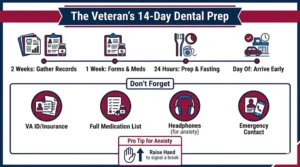
- 2 Weeks Before: Schedule/Confirm – Call Dr. Sayyar’s office to confirm date/time. Arrange transportation if needed (e.g. someone to drive you home after sedation). Gather documents listed above (VA ID, insurance, records) and begin filling any online forms.
- 1 Week Before: Complete Forms – Finish any paperwork (medical/dental history, COVID screening). Review your medication list – ask your doctor if any pre-visit med adjustments are needed. Ensure your dentures/partials are clean and in good condition.
- 48 Hours Before: Finalize Details – Double-check appointment time. Confirm with any family/friend who is coming with you. Lay out clothing and directions to arrive early. If required, schedule any pre-op labs or arrive prepared for any last-minute questions.
- 24 Hours Before: Pre-Visit Prep – Follow specific instructions (e.g. fasting if IV sedation is planned). Brush and floss teeth thoroughly. Avoid smoking or alcohol. Refill any prescriptions if needed. Review anxiety-management plan (bring headphones, review relaxation techniques).
- Day of Appointment: Arrival – Arrive ~15 minutes early to complete check-in. Bring all documents and completed forms. Use relaxation aids (deep breathing, music). Tell the front desk and staff if you feel anxious; we will ensure you are comfortable. After your appointment, have a ride home lined up if sedation was used, and plan to rest if needed.
timeline
title Pre-Appointment Timeline
2 Weeks Before: Confirm appointment & gather VA ID, insurance, records
1 Week Before: Complete forms & plan transportation
48 Hours Before: Double-check paperwork, finalize medication list
24 Hours Before: Follow fasting or med instructions, prep dentures
Day of Appointment: Arrive early with documents and bring relaxation aids
Printable Checklist (Two-Column Layout)
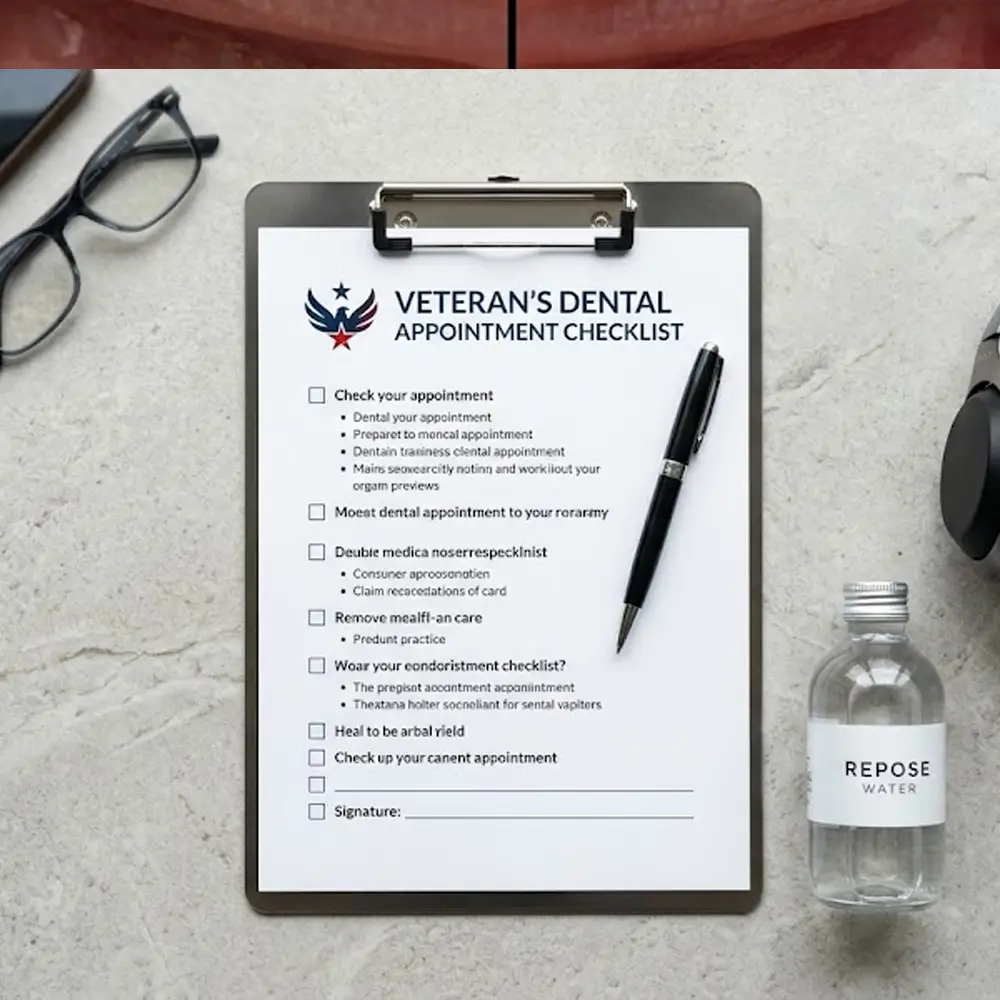
Below is a sample layout for a print-friendly checklist. You can tick off items as you go. (Click to download the PDF mockup.)
Figure: Sample two-column printable checklist (downloadable PDF).
Checklist: – Before Visit: Confirm date/time; arrange transport. Pack VA ID, insurance cards, health records, medication list. Complete any pre-visit forms. Check mobility/access needs.
– Medications: Continue prescriptions as directed. List anticoagulants and antidepressants; discuss these with dentist.
– Communication Plan: Note any anxiety triggers (light, sounds) to inform staff. Have headphones, stress ball or support person ready.
– At Arrival: Arrive ~15 min early. Submit IDs and paperwork. Ask questions about the exam/procedure steps before it starts.
– Post-Visit: Understand any post-care instructions (ice, diet, meds). Schedule follow-up if needed. Use emergency contact if complications arise.
Tip: Put this checklist on your fridge or in your wallet. Checking off each box ensures a smooth, prepared visit.
| Pre-Visit Tasks | Day-of Appointment |
| – [ ] Confirm appointment time/date | – [ ] Arrive 10–15 minutes early |
| – [ ] Bring VA ID and all insurance cards | – [ ] Bring completed forms (history) |
| – [ ] Pack medication list and records | – [ ] Follow relaxation plan (music) |
| – [ ] Prepare dentures/implants info | – [ ] Ask questions about each step |
| – [ ] Arrange transportation if needed | – [ ] Plan rest/ride home after sedation |
(Click the image above to open the full-size checklist template for printing.)
Frequently Asked Questions (FAQ)
Q1: What should veterans always bring to a dental visit?
A: Bring your Veteran Health ID card and any insurance cards, plus an updated list of all medications (name, dose, frequency). Also carry any relevant medical or dental records, and identification (driver’s license). Having your VA or private insurance info ensures your benefits are applied.
Q2: Do I need to stop my blood-thinning meds before dental work?
A: Generally no. ADA guidelines note that “for most patients, it is not necessary to alter anticoagulation or antiplatelet therapy prior to dental intervention”. Instead, the dentist will use pressure or local agents to control bleeding. Only stop or adjust meds if explicitly instructed by both your doctor and dentist.
Q3: I have severe anxiety/PTSD. How can the dental team help?
A: We understand this concern. Patients are encouraged to voice their worries before and during the appointment. Our office can provide options like a quiet waiting area, music/headphones, nitrous oxide or oral sedation. You can also schedule a “meet and greet” visit without any procedures to become comfortable. Remember, it’s OK to use a hand signal for a break at any time.
Q4: What if I don’t qualify for VA dental benefits?
A: Eligibility depends on service/disability status. If you don’t qualify for VA-funded care, consider the VA Dental Insurance Program (VADIP) which offers subsidized dental plans for enrolled veterans. Our office can also work with other insurance or provide a cost estimate so you can plan finances. Let us know your situation, and we can guide you on maximizing your coverage.
Q5: Are there COVID-19 protocols for my visit?
A: Our clinic follows current CDC recommendations. If you have fever, cough or any symptoms, please call to reschedule – CDC advises patients to “stay at home if sick”. Otherwise, usual precautions (sanitization, masks for staff) are in place. No special testing or vaccination proof is typically needed in 2026, but we’ll inform you if anything is required by local health guidelines.
Next Steps & CTA
Ready to schedule? If you’re a veteran in Glen Allen or Richmond, call Sayyar Family Dentistry at (804) 290-8001 to book your appointment. You can also contact our office online. Mention this checklist for a warm welcome and expert care. Our skilled dentists (many with military backgrounds) are ready to provide compassionate, pain-minimized dental treatment.
Note: This checklist is for informational purposes. Consult your dentist or physician for personalized advice.
Suggested Internal Link Anchors: For best user experience and SEO, use clear anchor text such as: – “Contact our Glen Allen dental office” → Contact Us page.
– “Prevent cavities with proven tips” → Cavity Prevention guide.
– “About Sayyar Family Dentistry” → About Us (team profiles and practice philosophy).
Meta Title (suggested): “Veteran Dental Visit Checklist – Glen Allen Dentist (Richmond VA)”
Meta Description (suggested): “Free printable checklist for veterans’ dental appointments in Glen Allen/Richmond, VA. Learn what to bring (VA ID, meds, records), VA benefits, anxiety tips, timeline prep, and more for a smooth, stress-free dentist visit.”
Sources: Authoritative guidelines from the VA, ADA, CDC and dental professionals were used (see citations above) to ensure accurate, up-to-date information specific to veterans and local (VA/Glen Allen) context.
Have a question about your smile?
Dr. Sean Sayyar and our team in Glen Allen, VA are here to help.