Gum Disease FAQs for Veterans in Petersburg & Glen Allen, VA
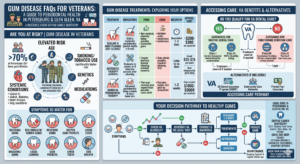
Executive Summary: Veterans often face higher rates of gum (periodontal) disease due to age, health history, and risk factors like smoking. This guide answers common gum disease FAQs veterans might have, including key periodontal questions vets ask. We define gum disease (gingivitis and periodontitis) and its symptoms, explain treatment options (non-surgical deep cleaning, antibiotics, surgery), and compare them in a summary table with indications, pros/cons, recovery and costs. We cover VA dental benefits so veterans understand what treatment the VA may cover, and suggest alternatives (VA Dental Insurance Program or private care) if not eligible. Local details for Petersburg and Glen Allen, VA, are provided – including our clinic location, hours, and contact. We include a decision-flow chart (symptoms → VA benefits check → appointment → treatment options) to guide veterans seeking care. Finally, a FAQ section (with JSON-LD schema) addresses typical gum treatment answers and a dental FAQ for veterans to wrap up the information.
Many veterans ask about costs, coverage, and outcomes; we provide evidence-based answers and clear next steps. To schedule a periodontal exam or ask further questions, call Sayyar Family Dentistry at (804) 290-8001 or visit our [Contact Us] page.
What Is Gum Disease (Periodontal Disease)?
Gum disease (also called periodontal disease) is an infection of the gums and supporting tissues around the teeth. It starts as gingivitis, a mild form where gums become red, swollen, and bleed easily. Untreated gingivitis can progress to periodontitis, a more serious condition that destroys gum attachment and even bone around teeth. Over time, the gums can recede and form deep pockets that trap bacteria. In severe cases, teeth may loosen and be lost. According to the ADA, periodontal disease is usually painless early on, so many people (including veterans) don’t realize they have it.
Periodontal disease is very common: about 47% of U.S. adults over 30 have some form of chronic periodontitis. Rates are especially high in older adults – over 70% of people 65+ have gum disease. Because veterans are often older and have a higher burden of chronic illnesses, they are at elevated risk. The VA’s research notes that “Veterans are older than the general population and therefore at higher risk of periodontal disease”. In short, gum disease is a major cause of tooth loss in adults, and veterans should be aware of it as a serious but treatable condition. Early detection and care are key to preventing tooth loss and health complications.
Symptoms and Signs to Watch For
The early signs of gum disease include gums that bleed easily, especially when brushing or flossing. Other warning signs can include gums that are red, swollen, or tender to the touch, gums that pull away from the teeth (recede), and bad breath that persists. You might also notice that your teeth appear longer (due to receding gums) or that partial dentures no longer fit as well. In periodontitis, symptoms may worsen: gum pockets deepen, infection spreads to bone (leading to bone loss), and teeth may become loose. Some people even experience heat/cold sensitivity or pain when brushing in advanced cases.
Because gum disease can be painless, regular dental exams are important. A dentist or hygienist will measure pocket depths around each tooth and take X-rays to detect bone loss. If you notice any of the above signs – especially persistent bleeding gums – see a dentist promptly. Early gum disease (gingivitis) is reversible with proper cleaning and hygiene. Once it progresses to periodontitis, treatment is needed to control the infection and prevent tooth loss.
Risk Factors – Why Veterans Are Vulnerable
Gum disease results from plaque and tartar buildup along the gumline. Poor oral hygiene (infrequent brushing/flossing) is the primary cause: plaque bacteria produce acids that irritate gums and form hard tartar if not removed. Veterans may have additional risk factors:
- Smoking or Tobacco Use: Tobacco users are far more likely to develop periodontal disease. Studies show tobacco is one of the most significant risk factors for gum disease. Historically, many veterans have higher smoking rates, which increases risk.
- Age and Gender: Risk rises with age. Over 70% of Americans 65+ have gum disease, and rates are higher in men (veterans are mostly male) than in women.
- Systemic Conditions: Conditions like diabetes, heart disease, COPD and stress-related illnesses (common in veterans) can worsen gum disease. The AAP notes that systemic diseases (e.g. diabetes) and stress impede the body’s ability to fight infection, increasing periodontal risk. The VA’s research also highlights that veterans often have chronic diseases linked to gum disease.
- Genetics: Some people are more prone to gum disease despite good care. Family history may play a role.
- Medications and Health: Certain medicines (like steroids or blood pressure pills) and health issues (e.g. immune problems) can affect gum health.
- Clenching/Grinding: Excessive bite force from grinding teeth can speed up tissue breakdown.
- Nutrition and Stress: Poor diet and high stress (common among veterans) weaken immunity and worsen gum health.
In summary, veterans often have multiple risk factors (age, smoking, chronic illness, stress) that increase periodontal disease risk. The good news is that with awareness and proper care, gum disease can be managed and even prevented. Simple measures like daily brushing/flossing (see our [Cavity Prevention] guide for flossing tips), quitting tobacco, and controlling diabetes all help protect your gums.
Periodontal Treatment Options
Gum disease treatment depends on severity. The goal is to stop infection and promote healing. For mild cases (gingivitis) brushing/flossing plus a professional cleaning may suffice. For periodontitis, three main approaches are used:
- Scaling and Root Planing (Deep Cleaning): This non-surgical procedure is the first line of defense. A dentist or hygienist removes plaque and tartar from above and below the gumline (scaling), then smooths (planes) the tooth roots to eliminate bacterial niches. This helps gums reattach to teeth and reduces pocket depths. Ultrasonic scalers and hand instruments are used. SRP is effective in early to moderate periodontitis; it can stop disease progression and promote healing. It is typically done by quadrant (one quarter of the mouth) over one or more visits.
- Antibiotic and Antimicrobial Therapy: To kill bacteria beyond cleaning, dentists may use antimicrobial rinses (like chlorhexidine) or antibiotics. This can be an oral antibiotic (pill form) or a locally-delivered antibiotic placed directly into deep pockets. For example, a powder (such as Arestin) can be applied into a cleaned pocket to provide sustained antibiotic release. Antibiotics help control infection, especially in aggressive or persistent cases. They do not replace cleaning; instead, they augment it. Patients must complete any prescribed oral antibiotics and maintain home care. Antibacterial mouthwashes (prescription chlorhexidine) may also be recommended post-treatment.
- Surgical Treatments: If non-surgical care is insufficient, periodontal surgery may be needed. The most common is flap surgery (pocket reduction surgery). In this procedure, gums are carefully lifted (flapped) away from teeth so the dentist can remove deep plaque/tartar and disease-involved tissue. Often osseous surgery (reshaping bone) is performed simultaneously: the jaw bone is smoothed and contoured to eliminate sharp defects that harbor bacteria. The gum tissue is then sutured back in a new position with shallower pockets. Sometimes regenerative techniques (bone grafts or membranes) are used to stimulate new bone growth. Flap surgery helps re-establish healthy gum contours and saves teeth that might otherwise be lost.
Other surgical procedures include gum grafts for severe recession (where gum tissue is transplanted to cover exposed roots) and guided tissue regeneration. These are more specialized and depend on the case. All surgical treatments typically require local or general anesthesia and suture removal later. Recovery involves careful maintenance and follow-up.
Each treatment has its own benefits and limits. The table below compares these options:
| Treatment | When Used (Indications) | Pros | Cons / Risks | Recovery | Typical Cost (approx.) |
| Scaling & Root Planing | Mild to moderate periodontitis (pocket depths 4–6 mm). Early disease. | * Non-surgical – no cutting. * Eliminates most plaque/tartar below gum line. * Reduces pocket depth and inflammation. * Can halt/reverse early disease. | * Multiple visits may be needed. * May cause soreness, bleeding, gum sensitivity afterwards. * Plaque can re-accumulate if not maintained. | * Mild discomfort or tenderness for 1–2 days. * Gums may bleed/feel tender. * Good home care speeds healing. | ~$200–$300 per quadrant (full mouth $800–$1200). |
| Antibiotic Therapy | As adjunct in moderate/severe periodontitis or if infection persists after cleaning. Often with deep/special cases. | * Targets bacteria beyond mechanical cleaning. * Local antibiotics (e.g. Arestin) deliver medicine directly, systemic antibiotics treat whole mouth. | * Possible side effects (stomach upset, yeast infection). * Risk of bacterial resistance. * Only effective with cleaning. * Additional appointment for local delivery. | * No recovery time for pills. * Local antibiotics: minor discomfort at application site. * Continue normal oral care. | * Arestin or similar: ~$35–$75 per treated tooth. * Oral antibiotics: usually inexpensive ($10–$50 for a course). |
| Surgical Therapy | Advanced periodontitis (deep pockets >6 mm), significant bone loss, non-responsive to non-surgical care. | * Allows thorough cleaning of deep roots and reshaping bone. * Can regenerate lost bone/gum in some cases. * Saves teeth that might otherwise need extraction. | * Higher cost and complexity. * Requires local (or sedation) anesthesia. * Post-op discomfort: swelling, pain, bleeding. * Risk of infection or gum recession. * Longer healing time. | * 1–2 weeks of discomfort/swelling. * Soft diet for several days. * Stitches removed in ~1–2 weeks. * Gums heal in ~4–6 weeks. | * Flap surgery: ~$1,000–$3,000 per quadrant. * Gum grafting: ~$600–$1,200 per tooth. |
| Maintenance (Follow-up) | After initial treatment, for all patients with history of periodontal disease. | * Prevents recurrence. * Monitors periodontal health. | * More frequent visits (every 3–4 months) than normal cleaning. * Some continued cost/effort. | * Little to no recovery; standard cleaning procedure. | * ~$150–$300 per maintenance visit. Typically 3–4 visits/year. |
Sources: Cost ranges from dental cost guides; treatment descriptions from VA health resources and ADA information.
The best treatment (or combination) depends on disease severity, patient health, and preferences. For example, scaling/root planing may suffice for moderate disease, while antibiotics can boost results. Surgery is reserved for deeper issues that cleaning alone can’t fix. These options are often staged: non-surgical care first, then re-evaluate, then surgery if needed.
Recovery and Aftercare
After any periodontal treatment, home care is crucial. Brushing twice daily and flossing at least once daily help gums heal and prevent re-infection. Your dentist will show proper brushing and flossing techniques, which is especially important for veterans managing chronic illness or medication effects on gums. For any treatment:
- Scaling/Root Planing: You may feel some gum tenderness or slight swelling for a day or two. Over-the-counter pain relievers and warm salt-water rinses can ease discomfort. Your gums may bleed a little when brushing for the first week. Good home care and possibly an antimicrobial rinse will promote healing. The ADA notes that SRP “greatly reduces harmful bacteria under the gums” and allows reattachment.
- Antibiotics: If prescribed oral antibiotics, finish the full course even if symptoms improve. Local antibiotics (in-pocket meds) cause minimal additional discomfort. Continue brushing gently around those sites. If you use a medicated rinse (chlorhexidine), do not eat or drink for 30 minutes after use.
- Surgery: Recovery takes longer. You will have stitches in your gums and possibly a protective dressing. Swelling and some pain for several days is normal. Eat soft foods, avoid the surgical area when chewing, and do not smoke (smoking impairs healing). Your periodontist will schedule a follow-up to remove stitches or any dressing. Once healed (often 1–4 weeks), you’ll likely see shallower gum pockets and firmer teeth. Good oral hygiene is vital – you’ll be advised to clean more carefully around the surgical site.
After treatment, ongoing periodontal maintenance visits are recommended (usually every 3–4 months). These involve deeper cleanings than routine check-ups to keep pockets under control. The cost per maintenance visit is similar to a deep cleaning (~$150–$300), but insurance often helps.
Modern practices also offer comfort options. For anxious veterans, sedation dentistry (oral sedatives or nitrous oxide) can make scaling or surgery stress-free. At Sayyar Family Dentistry, we strive to make every procedure as comfortable as possible, using technology and compassion to help you relax.
VA Dental Benefits for Veterans
Veteran health benefits for dental care are restricted. Unlike medical benefits, VA dental coverage is limited to specific categories. According to the U.S. Department of Veterans Affairs:
- Class I (Any Service-Connected Dental Condition): If you have a service-connected (SC) dental disability or condition for which you receive VA compensation, you qualify for any needed dental care. This means periodontal treatment (including scaling, antibiotics, surgery, etc.) is covered if it’s needed to treat that condition.
- Class IV (100% Disability Rating): Veterans with a 100% VA disability rating (from any cause, not necessarily dental) also get any needed dental care.
- Class IIA (SC non-compensable & Combat Wounds): Veterans with a service-connected, non-compensable dental condition—or with combat wounds—may get care “needed to make sure you have and can keep a functioning dentition”. Essentially, this covers treatments necessary to maintain a set of healthy teeth for chewing (often including deep cleanings or minor surgery).
- Class II (Gulf War): Veterans who served 90+ days in the Persian Gulf and meet certain conditions may have one-time care if applied within 180 days of discharge (generally not applicable long after service).
- Other Classes: Other categories (e.g. veterans in a Vocational Rehab program, or if dental issues worsen a SC health condition) have more limited benefits.
In short, most veterans unfortunately do not qualify for routine VA dental care. If you aren’t in one of the above classes, the VA will not pay for periodontal work as a matter of course. Many veterans mistakenly assume all VA healthcare includes full dental; it does not. For example, VA’s site clearly states only veterans with SC dental disabilities or 100% rating get any needed dental care.
If you are eligible (e.g. 100% rating or specific conditions), your periodontal treatment costs will likely be covered. Otherwise, veterans often turn to alternatives:
- VA Dental Insurance Program (VADIP): This is a subsidized private insurance that eligible vets can buy, to help cover dental care. It can help pay for cleanings, fillings, and even periodontal treatments not covered by VA.
- Community Care: Some regions have VA-authorized dental networks or demonstration programs that offer discounted or pro bono care to veterans (check with your local VA or veteran service organizations).
- Private Pay/Insurance: If ineligible for VA coverage, you may use private dental insurance, Medicaid/Medicare supplemental (if dental rider exists), or pay out-of-pocket. Payment plans or financing may be available through dental offices.
- Clinic Resources: Our clinic is experienced in working with veterans. We will help coordinate with any benefits you have (e.g. show you paperwork needed for VA classification) and offer flexible payment options if needed.
For detailed VA criteria, see the VA’s dental care page. But most importantly, don’t delay treatment waiting on coverage. Early periodontal care can be far less expensive and invasive than treating advanced disease (e.g. tooth loss and implants). Our practice will work with you to find the best solution, whether you have VA coverage or not.
Periodontal Care in Petersburg & Glen Allen, VA
Sayyar Family Dentistry & Associates serves Glen Allen and the greater Petersburg area, welcoming veteran patients. Our modern Glen Allen office is conveniently located at 5231 Hickory Park Drive, Suite E, Glen Allen, VA 23059. (That’s just north of Richmond, approximately 30 miles from Petersburg via I-95.) We provide comprehensive care including advanced periodontal treatment.
- Office Hours: Mon–Thu 8:00 am–5:00 pm; Fri 8:00 am–1:00 pm. Closed weekends. Evening hours by appointment.
- Contact: Call us at (804) 290-8001 to schedule an exam or ask questions.
- Online: Visit our [Contact Us] page for directions or to book online.
- Dentistry Team: Sean Sayyar is a master of dentistry and sedation, and our team includes specialists in preventive, restorative, and cosmetic care. (See our [About Us] page for details on our practice culture and team.)
- Veteran-Friendly Care: We understand veterans’ needs. Our office is family-oriented and friendly, with staff experienced in working with veteran insurance and VA paperwork. We offer flexible financing and community referrals if needed.
Because gum disease requires thorough ongoing care, we emphasize patient education. Our [Cavity Prevention] page, for example, highlights daily brushing and flossing techniques – the same hygiene habits that prevent gum disease. In fact, as Delta Dental notes, a “periodontal maintenance cleaning” (after treatment) is often needed for patients, costing about $140–$220 per visit.
We proudly serve all of Greater Richmond – including Petersburg, Colonial Heights, Hopewell, and surrounding Tri-Cities – for periodontal and general dentistry. You don’t have to be a Petersburg resident to visit us; veterans from anywhere are welcome. Our team will guide you through diagnosis, treatment planning, and aftercare.
If you suspect you have gum disease (bleeding gums, bad breath, etc.), do not wait. Gum disease is progressive but manageable. Call (804) 290-8001 or use our [Contact Page] to book an appointment today. Early treatment saves time, money, and stress later on, and preserves your natural teeth and health.
Decision Pathway for Veterans (Flowchart)
The chart below shows steps a veteran should consider when experiencing gum disease symptoms. It highlights checking VA benefit eligibility, seeking local dental care, and choosing treatment based on diagnosis.
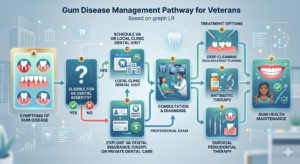
This pathway emphasizes: 1) recognizing symptoms, 2) checking if VA covers your care, 3) getting a professional exam, and 4) selecting appropriate treatment (which may include any combination of deep cleaning, antibiotics, and surgery) followed by maintenance. Even if VA doesn’t cover you, steps D→C show you can use alternate insurance or self-pay and still see a dentist. The final goal (Gum Health Maintenance) is ongoing oral hygiene and regular check-ups to keep periodontal disease under control.
Frequently Asked Questions
Q: What is periodontal (gum) disease and how serious is it?
A: Periodontal disease is an infection of the gums and bone supporting the teeth. It starts as gingivitis (gum inflammation) and can progress to periodontitis, where pockets form and bone is lost. Without treatment, teeth can loosen and fall out. It affects nearly half of adults over 30 in the U.S. and is a major cause of tooth loss. Early stages (bleeding, redness) are reversible, but advanced stages require intervention.
Q: What treatment options exist for gum disease?
A: Common treatments include deep cleanings (scaling and root planing), antibiotics, and possibly surgery. A deep cleaning removes tartar below the gumline and smooths roots to reduce infection. Antibiotics (oral or local) help kill bacteria that remain after cleaning. Surgery (flap/pocket reduction) is done for severe disease to lift gum tissue, clean deep pockets, and reshape bone. See the table above for a side-by-side comparison of these treatments’ indications, benefits, and recovery.
Q: As a veteran, do I qualify for VA coverage of gum disease treatment?
A: Only certain veterans qualify for VA dental care. For example, those with a service-connected dental condition or a 100% disability rating are eligible for “any needed dental care,” which would include periodontal treatment. Other categories (combat wounds, former POW, some Gulf War vets) have limited benefits. Most veterans do not get free VA dental care. If ineligible, consider the VA Dental Insurance Program or pay privately. In any case, get treatment promptly – periodontal care is often far cheaper and less invasive early on.
Q: What are the costs if I have to pay out-of-pocket?
A: Costs vary by treatment. As a rough guide, deep cleaning (scaling/root planing) is about $200–$300 per quadrant (roughly $800–$1,200 for full mouth without insurance). Periodontal maintenance cleanings run about $150–$300 per visit. Flap surgery is higher – around $1,000–$3,000 per quadrant. Gum grafts (if needed) can be $600–$1,200 per tooth. Local antibiotic therapy (like Arestin) costs on the order of $35–$75 per tooth. Insurance can cover 50–80% of these costs, so check your plan. (Many offices, including ours, offer payment plans.)
Q: How can I prevent gum disease from getting worse?
A: Daily oral hygiene is your best defense. Brush twice a day and floss at least once daily – even one good floss per day can remove plaque where a toothbrush can’t. Use an antiseptic mouthwash if recommended. Avoid tobacco, control diabetes and other health conditions, and manage stress. See your dentist regularly for cleanings. Our [Cavity Prevention] page has useful tips on brushing and flossing that apply to gum health too. Early attention to bleeding gums often stops gingivitis from turning into periodontitis.
Q: Where can I get periodontal care in Petersburg/Glen Allen, VA?
A: Veterans in Petersburg and the surrounding area can visit Sayyar Family Dentistry & Associates in Glen Allen for periodontal evaluation and treatment. We offer comprehensive gum disease care at 5231 Hickory Park Dr, Suite E, Glen Allen. Call (804) 290-8001 to schedule an appointment. We welcome veterans and will work with your benefits or insurance. Local VA dental clinics (Richmond VA) may not accept walk-ins for gum treatment, so many veterans come directly to community dentists like us. Don’t delay – the sooner you address symptoms, the better the outcome.
Q: Can gum disease affect my overall health?
A: Yes. Research, including VA studies, links periodontal infection to increased risk of diabetes complications, heart disease, stroke and lung disease. Treating gum disease can modestly improve inflammation markers and blood sugar control. For diabetic veterans, in particular, controlling gum disease is important for overall health. Your dentist will coordinate care and may communicate with your physician if systemic issues are involved.
Q: I have bleeding gums but no pain. Should I see a dentist?
A: Absolutely. Periodontal disease is often painless until late stages. Bleeding gums (especially daily) is a red flag. Early treatment is key. We recommend you visit a dentist for an exam – either in the VA system if eligible, or in our clinic. We’ll assess your gum health, measure pockets, and propose a treatment plan. Early gingivitis can often be treated with just a deep cleaning and improved home care.
Have a question about your smile?
Dr. Sean Sayyar and our team in Glen Allen, VA are here to help.