
New Veteran Dental Benefits: Has VA Coverage for Gum Treatments Improved?
Veterans often face higher rates of gum disease (periodontitis) due to factors like past injuries, smoking, or diabetes. Periodontitis is “an inflammatory disease of bacterial etiology resulting in loss of periodontal tissue attachment and alveolar bone,” which can lead to gum recession and tooth loss. Treatment ranges from deep cleanings (scaling and root planing) to surgery (like gingivectomy), followed by regular periodontal maintenance to prevent recurrence. In this article, we review recent VA dental policy changes and whether they improve coverage for gum treatments, compare VA benefits to typical private dental plans, and outline how veterans in Petersburg and Glen Allen, VA, can access care.
Understanding Gum Disease and Treatments
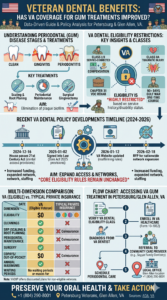
Periodontal disease (gum disease) progresses in stages (mild to severe) and requires escalating care. The American Dental Association (ADA) notes that without treatment, periodontitis can destroy tooth-supporting structures. Early on, gingivitis (gum inflammation) can be reversed with hygiene, but once periodontitis develops, patients remain susceptible to relapse without ongoing care. Key periodontal treatments include:
- Scaling and Root Planing (SRP): A deep cleaning below the gumline to remove plaque/calculus from tooth roots. ADA guidelines recommend SRP as the initial definitive therapy for chronic periodontitis. Typically, insurance allows SRP once per quadrant every 1–2 years, depending on disease severity.
- Periodontal Maintenance: After active treatment, “life‐long supportive care” with regular maintenance visits (often every 3–6 months) is advised to monitor and clean beyond routine hygiene. This helps catch any recurrence early. Private plans may cover maintenance with limits (e.g. two maintenance visits per year) if periodontal history is documented.
- Gingivectomy and Surgery: For advanced pockets, surgical procedures like gingivectomy (removing excess gum tissue) or flap surgery may be needed. These are more invasive and usually only covered by insurance when medically necessary. VA benefits cover “moderate, severe, or complicated” periodontal conditions (see eligibility below), which would include such surgeries if deemed needed by a VA dentist.
Proper treatment of periodontitis aims “to eliminate plaque biofilm” and restore oral health. ADA guidelines emphasize personalized treatment based on individual factors. Gingivectomy (gum tissue removal) and bone grafts (to restore lost bone) are examples of advanced therapies often limited to severe cases. In all cases, prevention through daily brushing, flossing, and regular cleanings is critical; our Cavity Prevention page offers tips on oral hygiene that benefit gum health.
VA Dental Benefits and Gum Treatments
Veterans qualify for VA dental care only under certain conditions (benefit “classes”), but when eligible, the VA aims to cover all needed care related to service-connected conditions or trauma. For example, VA policy states that qualifying veterans may receive care to “treat moderate, severe, or complicated gingival and periodontal conditions”. In practice, this means an eligible veteran who is diagnosed with serious gum disease by a VA dentist would have procedures like SRP, periodontal maintenance, or even surgery covered at VA expense. Copays are generally $0 for VA-covered services; eligible veterans receive care without co-insurance, unlike most private plans.
Eligibility and Classes for VA Dental Care
VA dental benefits are highly restricted compared to general health benefits. Eligibility depends on factors like service history and disability status:
- Class I/II (Service-Connected): Veterans with a service-connected dental disability (compensable or 100% disabling) or former POW qualify for any needed dental care. Periodontal treatments are covered as “needed” here.
- Class IIA (Traumatic Injury): Veterans with combat wounds or injuries affecting oral health can get care to maintain a “functioning dentition”, which may include gum disease treatment if related to the trauma.
- Class II/III/V (Other Eligibility): For example, veterans in a vocational rehab program (Chapter 31) or whose health condition is worsened by dental issues may get dental care if a VA provider deems it necessary. Notably, veterans on active duty for 90+ days in the Gulf War era can receive a one-time course of dental care if they apply within 180 days of discharge (this still requires a qualifying dental issue).
Recent change: The Veterans Healthcare and Benefits Improvement Act (the “Dole Act” of Jan 2025) includes provisions for dental coverage improvements. It authorizes pilot programs to extend dental care to veterans otherwise ineligible (e.g. those with heart disease) and mandates reviews of VA dental access. While most new law provisions focus on expanding access and funding for VA dental staffing and community care networks, they do not explicitly alter the core eligibility classes. In other words, coverage of periodontal treatment still depends on meeting one of the VA benefit classes, but new programs may help more vets get connected to care.
For specific gum treatments under VA: eligible veterans can receive scaling and root planing and periodontal maintenance with no fixed dollar limit, as long as the treatment is “needed” for a covered condition. For example, a 100%-disabled veteran (Class I) who develops periodontitis would get SRP or surgery just as any dental patient would, with all costs covered. However, a veteran not in an eligible class has no VA coverage for gum treatment and would need private insurance or programs like VADIP.
Recent and Upcoming VA Dental Policy Updates
Recent years have seen legislative and administrative efforts to improve VA dentistry:
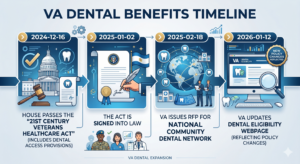
– Dec 16, 2024: The U.S. House passed the “21st Century Veterans Healthcare Act” with strong bipartisan support. This law (signed Jan 2, 2025) enhances overall VA health access and directs studies and pilot programs related to dental care (e.g. examining VA community care reimbursement and launching new outreach programs).
– Jan 2, 2025: President Biden signed the act into law. Among its provisions, it supports expanding pilot programs for VA dental access (though most focus on hard-to-reach veterans rather than specific procedures).
– Feb 18, 2026: VA issued a request for proposals (RFP) to build a new nationwide dental provider network. The goal is a “robust national network” of general and specialty dentists to improve access, including preventive and restorative services. This indicates VA’s intent to beef up capacity in its Community Care program, potentially making it easier for eligible veterans to get gum treatment from VA-paid providers outside VA facilities.
– Jan 12, 2026: The VA updated its online “About VA health benefits – Dental care” page, reaffirming coverage rules. (The updates may reflect changes in law or policy clarifications.)
– Ongoing efforts: Legislators continue to discuss bills to widen eligibility (e.g. H.R. 210 to treat dental care like other health specialties) and to increase VA dental staffing. For now, no new VA rule has expanded the benefit classes themselves.
Below is a timeline of key recent developments:
VA vs Private Dental Coverage for Gum Disease
| Coverage Category | VA (Old Policy) | VA (New/Current) | Typical Private Insurance |
| Eligibility (Who qualifies) | Very limited (only Class I/II/IIA, etc.). | Same core classes apply; some pilot programs may help new groups. | Any insured person (individual/family plan) typically. No military connection needed. |
| Preventive Cleanings | Covered if “needed.” Often only for eligible classes (Class I/II). No fixed limit stated. | Same; eligible vets can get cleanings (often code D1110/D4910) as needed. | Usually 2 cleanings/year (adult prophylaxis) covered fully. Premium plans may allow more. |
| Scaling & Root Planing (SRP) | Covered if needed for periodontitis in eligible vets. No copay. | Still covered “as needed” under VA benefit classes. | Often covered once per quadrant per 1-2 years, with copay (e.g. 20-50% coinsurance). |
| Periodontal Maintenance | Covered as needed. No fixed frequency cap for eligible vets. | Same – VA dentists schedule maintenance based on disease. | Covered if patient has history of periodontitis; usually limited to 2-4 visits/year, with copays. |
| Gingivectomy/Periodontal Surgery | Covered when needed for severe cases in eligible vets. | Same coverage for eligible veterans. | Covered only if deemed medically necessary (not cosmetic). Often subject to plan approval and coinsurance. |
| Dentures/Implants | Dentures are covered for eligible vets; implants rarely covered (may be allowed for jaw reconstruction). | No major changes known. Some VA community care may handle implants case-by-case. | Dentures typically covered under major services (partial benefit). Implants vary by plan (often excluded or limited). |
| Copays/Out-of-Pocket | $0 copay on covered VA dental care. | Same – VA dental care for eligible vets is free. | Usually 20–50% coinsurance or fixed copays on major services. Also annual maximums (often ~$1,000–$2,000). |
| Annual Limits/Waiting Periods | No monetary limit; veterans with coverage can get care repeatedly if needed. Waiting period applies only to post-discharge Gulf War one-time care. | Same, though new pilots may reduce waiting for some. | Many plans have waiting periods (often 6–12 months) for major services. Benefit maximums and frequency limits apply. |
Table: Comparison of VA dental coverage for gum treatments (old vs. current) and typical private insurance. VA dental benefits remain restricted to qualifying veterans, but eligible vets receive fully funded care with no copays. Private plans usually cover periodontal treatments partially, with limits and cost-sharing.
Getting Gum Treatment as a Veteran
- Check your VA eligibility. First, ensure you fall into one of the VA dental benefit classes (service-connected disability, trauma, Chapter 31, etc.). If unsure, contact your local VA or see the VA dental benefits page for class details.
- Enroll in VA health care. Even if you’re eligible for dental, you must be enrolled in VA health care. Apply online (VA Form 10-10EZ) or through a VA Regional Office.
- Obtain a dental referral. If eligible, visit a VA dental clinic or request a referral through the VA’s Veterans Community Care Program. With the new dental network, community providers (private dentists) can serve you at VA expense.
- Diagnosis and treatment plan. A VA dentist will assess your gums and may chart pockets, measure attachment loss, etc. (advanced periodontitis is diagnosed by attachment loss). They will recommend needed treatments – typically SRP and maintenance if periodontitis is present.
- Schedule and follow-up. VA will cover the prescribed treatment plan. Many veterans find it helpful to receive care at local practices that accept VA community care. Sayyar Family Dentistry in Glen Allen is credentialed to work with VA patients in the Richmond/Petersburg area. We help eligible veterans schedule timely periodontal care (by calling +1 (804) 290-8001 or visiting our Contact page).
Recommended next steps: Maintain strict oral hygiene (brushing and flossing) to complement VA-provided cleanings. Stay on a 3–4 month maintenance recall as recommended by your periodontist. If you do not currently qualify for VA dental benefits, consider the VA Dental Insurance Program (VADIP), a discounted private dental plan for vets (see VA Dental Insurance Program on VA.gov).
Call to Action: If you’re a veteran in Petersburg or Glen Allen, VA with gum disease concerns, reach out! Our office at 5231 Hickory Park Dr, Suite E, Glen Allen, VA 23059 (serving the Petersburg area) is accepting new VA patients. Contact us at +1 (804) 290-8001 or schedule an appointment online to discuss how we can help preserve your oral health.
FAQ
Sources: Authoritative sources were used, including VA.gov benefit pages and official VA news, as well as ADA materials and news on dental care policy. Contact and location details are from Sayyar Family Dentistry’s official site.
Have a question about your smile?
Dr. Sean Sayyar and our team in Glen Allen, VA are here to help.