
How Veterans Can Use Both VA and Private Dental Insurance for Gum Treatment
Veterans in Petersburg and Glen Allen, VA have unique dental insurance options. Many qualify for VA dental benefits and may also carry private dental insurance (through an employer, spouse, or VA’s own insurance program). Combining these benefits can help cover costly gum (periodontal) treatments and reduce out-of-pocket costs. However, using two plans requires understanding coordination of benefits (COB) rules, so you don’t double-bill or leave gaps. In this guide, we explain how VA dental coverage works for periodontal care, what private insurance typically covers, and how the two interact. We’ll also highlight steps to verify coverage and encourage you to contact our office for personalized help.
VA Dental Benefits for Veterans
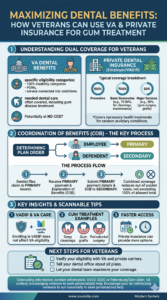
The Department of Veterans Affairs (VA) offers dental care for vets under specific eligibility categories. Not all veterans automatically qualify for VA dental services, but if you do, “any needed dental care” – including gum disease treatment – may be covered. For example, the VA website states that certain veterans (such as those with a 100% service-connected disability, former POWs, or service-connected oral conditions) “may qualify for: any needed dental care”. Similarly, the VA’s benefits literature notes that it aims to “treat your moderate, severe, or complicated … periodontal conditions (gum infections that can lead to pain, swelling, and bone and tooth loss if not treated)”. In practical terms, this means if your gum disease is linked to a service-connected health issue or disability, the VA will often pay for the deep cleanings, surgeries, or other periodontal procedures needed to treat it.
Eligibility is key. Classes I, II, IV, and V veterans (e.g. 100% disabled, POWs, etc.) get comprehensive VA dental care, often at no cost. Other vets may get a one-time post-discharge treatment or dental care related to ongoing medical conditions. If you aren’t eligible for free VA dental care, VA still offers the VA Dental Insurance Program (VADIP). Through VADIP, enrolled veterans (and eligible dependents) can buy discounted private dental plans from Delta Dental or MetLife. These VADIP plans cover a wide range of services – from exams and cleanings to root canals, extractions, and emergency care – and they even include periodontal treatments. Importantly, enrolling in VADIP is voluntary and “does not affect eligibility for VA outpatient dental services and treatment.” In other words, getting a VADIP plan won’t make you lose your VA dental benefits.
For Petersburg/Glen Allen veterans, our practice can help verify your VA eligibility. If you have an assigned VA dentist or are registered in VA health care, we can coordinate your care to use VA coverage for gum disease when possible. Even if the VA will pay for your needed treatment, having a private plan or VADIP can provide additional network options and possibly faster appointments.
Private Dental Insurance Coverage for Periodontal Care
Most private dental insurance plans – employer-sponsored, individual, or VADIP – categorize services into preventive, basic, and major care. Preventive care (cleanings, routine exams, X-rays) is usually covered at 100%, up to your plan’s frequency limits. Basic restorative care (fillings, simple root canals, periodontal maintenance) is often covered at 70–80%. Major services (gum surgery, crowns, dentures) may be covered at 50%. For gum disease specifically, plans commonly view it as a necessary health treatment. In fact, dental experts note that “dental insurance often covers scaling and root planing,” and “in many cases, a dental plan will cover half of a scaling and root planing’s cost.” (Scaling and root planing are the deep cleanings needed when gum pockets form.) Coverage for surgery (gum grafts, flap surgery) varies by plan but generally falls under the major-services tier.
Plans also have annual maximums (often $1,000–$2,000 per year) and deductibles. This means once your plan pays its limit, you pay out-of-pocket. Private insurance typically won’t cover cosmetic procedures (like teeth whitening), but it will cover periodontal treatment that’s needed for health. It’s wise to check your own policy (or call your insurer) to see exactly what gum treatments are covered and at what percentages. Your dentist’s office can help file claims and explain any copayments.
If you have a private plan through VADIP (VA’s program), note that these are PPO plans and you can go to almost any dentist. VADIP premiums are generally lower than standard private plans. For example, one estimate shows individual VADIP plans often run $20–$45 per month, whereas typical private plans might start around $50–$70. Both cover periodontal care, but with VADIP you often save on premiums and can keep your VA doctor’s referral in place.
Coordination of Benefits (Dual Coverage Rules)
When you have two dental plans (VA/VADIP and a separate private plan, or two private plans), coordination of benefits (COB) rules determine how the costs are shared. Coordination of benefits ensures you don’t get “double paid” by having two insurance companies both cover 100% of the bill. Instead, one plan pays first (the primary plan) and the other (the secondary plan) may pay remaining eligible costs up to the allowed total.
In general, the primary plan is the one where you are enrolled as the primary member (for example, your employer’s plan). The secondary plan is typically where you are a dependent (for example, on a spouse’s plan or a retiree plan). As the American Dental Association explains, “the primary plan is the one in which the patient is enrolled as an employee or main policyholder; the secondary plan is the one in which the patient is enrolled as a dependent.” For example, if a veteran carries dental coverage through their own job, that plan is primary; if they are also on their spouse’s plan, the spouse’s plan is secondary. In most cases, the secondary plan won’t even process your claim until the primary plan has paid its share. The dentist’s office sends a claim to your primary carrier first, gets back an Explanation of Benefits (EOB) showing what was paid, and then submits the balance (with the EOB) to the secondary carrier.
Delta Dental’s insurance guides summarize this: “Dual coverage doesn’t double your benefits, but you might pay less for dental procedures than if you were covered under just one plan because treatment costs may be shared between your two carriers up to 100%.” In other words, your combined coverage can pay up to 100% of the dentist’s allowed fee, but you won’t get more than the cost of the service. If the primary plan covers 80% of a cleaning and the secondary covers another 20%, that cleaning can effectively be 100% covered. If both cover 80%, you still only get the service covered once (80% by primary, and perhaps no balance left for secondary). State laws and plan contracts vary, so it’s crucial to check each insurer’s COB rules.
In practice: always submit to the primary insurer first. After that payment, ask the dentist to bill the secondary plan for any remaining eligible costs. You’ll likely need to show the secondary plan the primary plan’s EOB. Our office can help by filing claims in the correct order. Remember, COB does not increase your total benefit; it just may reduce what you owe out-of-pocket.
Using VA and Private Benefits Together for Gum Treatment
When it comes to gum (periodontal) treatment, here’s how dual coverage typically works for veterans:
- If you receive care at a VA dental clinic: The VA will cover the portion of treatment you qualify for. VA dental clinics generally do not bill private insurance directly for services, since VA facilities operate on federal funding. (There is a policy that VA can bill private health insurers for medical services under some conditions, but this is generally for non-dental care.) In practice, if you’re in a VA program that covers gum treatment, the VA dentist will provide the care at no charge to you (except any minimal VA copays). Your private dental insurance would not be billed in this scenario. However, you can still use private insurance for dental work done at a civilian dentist.
- If you see a civilian dentist (non-VA) for gum treatment: Your private insurance plan is typically the primary payer if it’s your main coverage. The dentist will file the claim under that plan first. Any remaining costs (such as if you have a secondary carrier or a VADIP policy) can then be submitted. If you also have VADIP, you would list your VADIP plan as primary only if your civilian coverage is dependent; otherwise, it could become secondary. Be sure to tell the office about all your plans so they can coordinate correctly.
- VADIP and private employer insurance: VADIP is a private insurance program open to VA-enrolled veterans. It works like any other dental plan. If you are covered by both VADIP and another plan, you apply the same COB rules as above. For example, if your employer’s plan is primary and VADIP is secondary, you file with the employer plan first. VADIP could then cover some remaining balance up to its limits. Conversely, if you enroll in VADIP and have no other plan, VADIP is simply your sole plan.
- Maximizing both benefits: Since “enrollment [in VADIP] does not affect eligibility for VA outpatient dental services”, a veteran can freely use their VA dental benefits and VADIP. One strategy: use the VA for qualifying service-related or urgent periodontal needs (if applicable) and use private insurance (VADIP or employer) for any care not covered by VA, or for convenience of provider. For example, if you need a gum graft or regular maintenance cleanings, and your VA benefits cover it, those can go through VA at little/no cost. If your VA service is limited or you prefer a civilian provider, you could use your private plan (after confirming COB). Always verify details: call your plan’s customer service and check with our billing team. Insurance terms vary widely, and we can help clarify them – just contact us if you’re unsure.
Ultimately, communication and verification are key. As Delta Dental advises, you should “talk to both insurance carriers to fully understand if and how dual coverage could benefit you.” Our office staff can assist by checking your benefits with multiple carriers. We encourage veterans to reach out before major gum treatment.
Frequently Asked Questions (FAQ)
Q: Can I use my VA dental benefits and my private dental insurance together?
A: Yes. You can have both. Typically, you will use one as primary and the other as secondary. For example, if you see a private dentist, file your claim with the primary plan first (often your employer’s plan) and then have the secondary plan pick up remaining costs. If receiving care at a VA clinic, the VA covers what you are eligible for, and you would then use private insurance for any additional treatment done elsewhere.
Q: Will having two insurance plans mean double the coverage?
A: No. Dual coverage doesn’t double your benefits, but it can reduce your out-of-pocket cost. As one source explains, “having dual coverage doesn’t double your benefits, but you might pay less for dental procedures because treatment costs may be shared between your two carriers up to 100%”. In other words, your combined plans can cover up to the full allowed cost of a service, but you can’t get more than 100%. The secondary plan only pays part of the remaining cost after the primary pays its share.
Q: How do I know which of my two plans is primary?
A: Generally, the plan that covers you as the member (for instance, your employer’s or your own VADIP plan) is primary, and the plan that covers you as a dependent (a spouse’s plan or a retiree plan) is secondary. If you have dental coverage through two employers, the one that’s been in place longer is usually primary. The primary plan’s benefits apply first.
Q: What does “coordination of benefits” mean for me?
A: Coordination of benefits (COB) is the process insurances use to divide costs when you have more than one policy. Under COB, the secondary insurer won’t pay until the primary insurer has paid and typically requires the primary plan’s Explanation of Benefits (EOB). Laws in many states require this coordination to prevent overpayment. Always follow the dentist’s office instructions on submitting claims in the correct order.
Q: Does VADIP affect my VA care?
A: No. Enrolling in the VA Dental Insurance Program (VADIP) is voluntary. VA’s federal benefits guide specifically says that enrolling in VADIP “does not affect eligibility for VA outpatient dental services and treatment.” This means you can have VA-covered dental benefits (if you qualify) and still sign up for VADIP to get additional coverage. Using VADIP simply gives you an extra plan; it won’t reduce or replace what VA would cover.
Q: How can I get periodontal (gum) treatment covered?
A: If you’re eligible, VA dental benefits will cover needed gum treatments tied to service-connected conditions. Otherwise, private insurance plans typically cover gum therapy (cleanings and surgeries) as a necessary dental procedure, often reimbursing around 50–80% of the cost. Start by having a periodontal exam. Our office will check both your VA status and private insurance to determine your coverage. We can help you file claims to both plans to maximize what you pay.
Q: I have severe gum pain – what should I do?
A: Gum pain can be urgent, especially if it’s a periodontal abscess or infection. Contact our office immediately or visit our Emergency Dentistry page for guidance. We will help you schedule a prompt evaluation. Once treated, we can follow up with insurance billing to see how your VA or private plans cover the work.
Next Steps & Getting Started
Understanding dual dental coverage may feel complex, but you don’t have to navigate it alone. At Sayyar Family Dentistry in Glen Allen (serving Petersburg and Glen Allen, VA), we routinely assist veterans with both VA and private insurance. Call our office at (804) 290-8001 or visit our Contact Us page to book an appointment. We can review your insurance details, explain your VA dental benefits, and work with your private plan. Whether you need a gum disease evaluation, routine cleaning, or emergency care, our trusted team is ready to help. Rest assured, your oral health and peace of mind are our priority – let us guide you through the insurance process so you can get the gum treatment you need without confusion or excessive cost.
Sources: We’ve based this information on official VA and insurance resources. For example, VA’s guide explains its dental insurance program and notes that companies like Delta and MetLife offer plans to veterans. The ADA and major insurers describe how coordination of benefits works for two dental plans. Dental experts note that gum disease treatments are serious but often partially covered by insurance. Always verify details with your insurers and our staff for the most accurate, up-to-date guidance.